Retail media trends shaping 2027, and what they mean for mobile
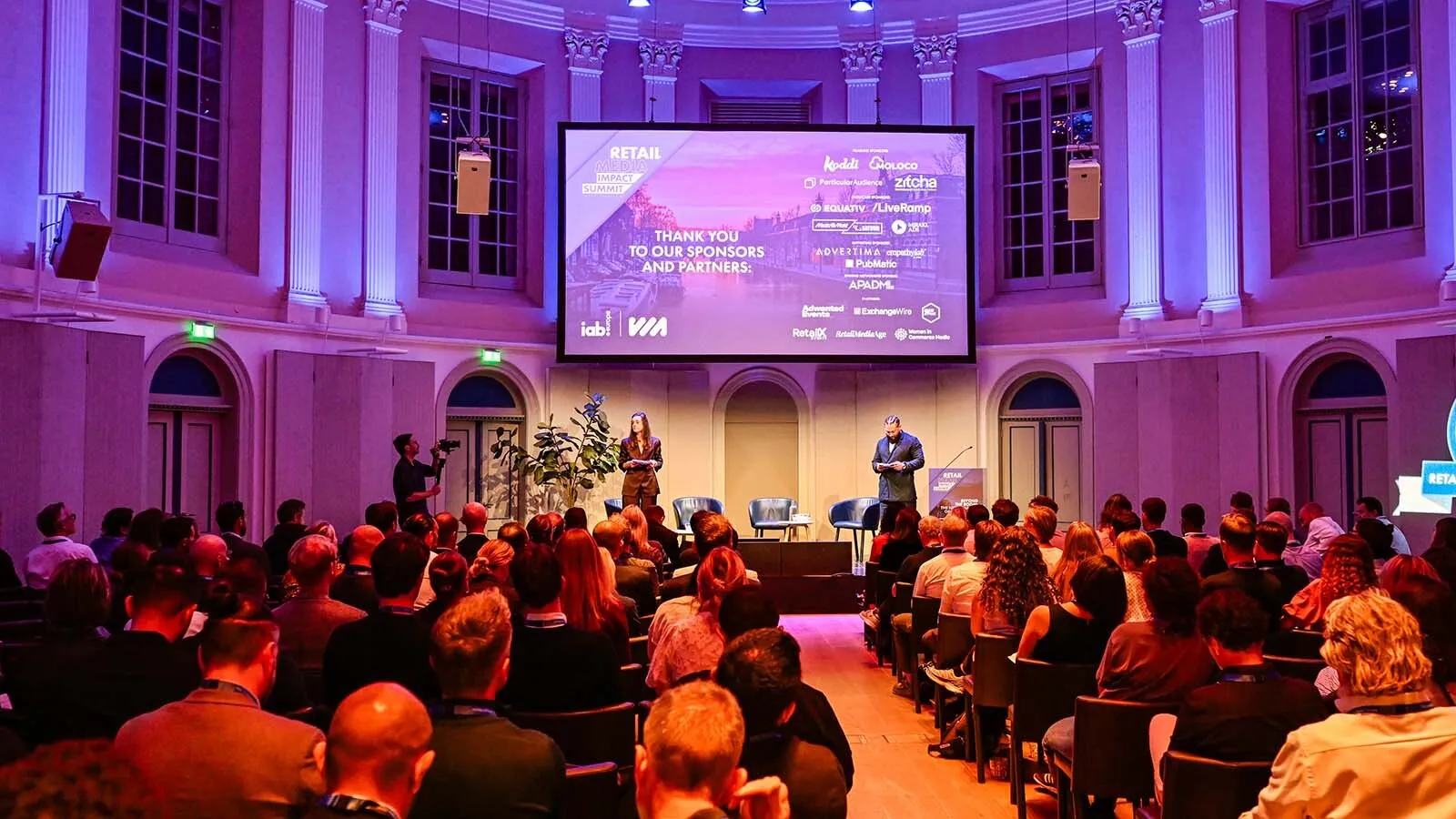
Retail media isn’t the new kid on the marketing block any more, but many brands still have some way to go before utilising it to its full potential. Apadmi’s mobile experts recently headed to IAB Europe’s Retail Media Impact Summit to explore where the channel goes next in 2027.
The headline? Retail media has grown up. The pilot phase is over, the money is real and boardrooms are paying attention. But maturity brings harder questions. Can it prove its value? Can it scale without spoiling the shopping experience? And who owns the customer when AI agents start doing the shopping?
With nearly half of UK shoppers now using apps as their main way to make purchases, these are the trends worth paying attention to.
From side hustle to profit engine
IAB Europe research shared at the summit found 71% of European buyers have now partnered with retailers for over a year, up from 51% in 2024.
The reason retailers care comes down to simple maths. IAB Europe Chief Economist, Daniel Knapp, set typical retail margins of around 6% (roughly €1 of surplus for every €17 of goods sold) against retail media margins of 65–70%. With much of retail’s recent revenue growth coming from higher prices rather than more products sold, a relatively small advertising business can make an outsized difference to profit.
Boards have noticed. Among the listed European retailers Knapp’s team analysed, the number discussing retail media on earnings calls has more than doubled in three years. Frasers Group now talks of a “meaningful incremental profit contribution across the portfolio”, while Ocado reported £98m of supplier-funded media income.
What it means for mobile: if retail media is a profit line, the app is prime real estate. It’s where your most loyal, logged-in, high-frequency customers spend their time, which makes app inventory some of the most valuable media a retailer owns. Ad placements need to be designed in, owned and measured like any other commercial feature.
Proof over promises
If there was one theme that ran through every session, it was measurement. IAB Europe’s data shows buyers have moved the case for retail media up the funnel: the share asking for ROAS fell from 89% to 49% in a single year, overtaken by unified reporting, new-to-brand and incrementality.
Meanwhile, 61% now name measurement and reporting as their top barrier, and the share citing a lack of available data has jumped from 31% to 58%.
Colgate-Palmolive and VML’s session, aptly titled Proof Over Promises, showed what good looks like. Rather than letting Amazon Marketing Cloud insights die in a PDF, they built a simple, repeatable loop: start with a business question, run a three-to-four-week test, evaluate, then scale, retire or retest. One analysis found 2% of shoppers drove 82% of sales. Building audiences around those shoppers’ signals delivered a 65% uplift in ROAS.
Just as important, they were candid that tests fail, and that anyone promising only winners is selling rather than learning. Their measure of success was whether the team knows what to do differently next month.
MediaMarkt’s Lieke Buisman showed the same honesty. Its campaign with Opel reported a 160% rise in leads and roughly double the orders, but she was clear there was no control group and TV was running at the same time. An independent Kantar study was commissioned to show MediaMarkt’s actual contribution.
What it means for mobile: apps produce some of the cleanest first-party signals a retailer has: persistent logged-in identity, loyalty links and event-level behaviour. But only if they’re built for it. That means a consistent analytics taxonomy, solid consent management, the ability to run controlled tests and holdouts, and a way to connect in-app ad exposure to purchases online and in store. Data only matters if it changes the next decision.
Make it easy, keep it relevant
Knapp argued that retail media needs an “easy button”. Every custom ad format and every extra platform adds work for advertisers, and friction is a reason not to spend.
Debenhams has taken that to heart. Working with Mirakl Ads, it put advertising inside the marketplace back office sellers already use, migrated almost every existing campaign on day one, and went live in around three weeks, just ahead of peak trading. Its largest advertisers drive more than 80% of spend, but self-serve tools mean the long tail of smaller brands can get started too.
The flip side of easy is relevant. Debenhams described inventory as a constant balancing act: an ad that displaces a product the customer would have bought is a bad trade, however much it earns. Sometimes that means fewer placements until there’s enough relevant demand to fill them.
Knapp’s data showed the right model also depends on the journey. In electronics and beauty, a few prominent “hero” slots near the top of results do the heavy lifting. In fashion and marketplaces, where shoppers scroll and browse, ads are spread through the experience.
What it means for mobile: a smaller screen means fewer slots, so each one carries more weight. The best app ad formats feel native, built from the app’s own design system and rendered by the app, so brands supply assets rather than bespoke builds. Placement strategy should follow how customers actually move through the app, rather than a desktop template. On top of this, ads must never slow the app down, because sluggish performance shows up in reviews, ratings and conversion well before it shows up in a media report.
Beyond the shelf, beyond the site
Retail media’s first decade was built on suppliers advertising their own products. That’s starting to hit a ceiling, and the next wave of growth is coming from further afield.
MediaMarkt’s partnership with Opel was the standout example. Car dealerships are often out of town, so getting buyers to see a new model takes effort. MediaMarkt brought the Opel Frontera to them instead, putting the car in 25 of its Dutch stores during back-to-school, playing it across walls of TV screens and backing it with web placements and newsletters to more than a million inboxes. Non-endemic advertising is still a small slice of MediaMarkt’s retail media revenue, but Buisman hopes it reaches at least 10% within three years.
The guardrail is relevance; MediaMarkt prefers partners with a natural link to its shoppers (an ice cream brand next to fridges, pet food next to automatic feeders) and wants to protect the novelty. One car activation works, but a different car every week doesn’t. Both MediaMarkt and Debenhams also flagged off-site media as the next growth area.
What it means for mobile: the phone is the bridge between store and screen. An in-store activation can follow the customer home through in-app content, push notifications and loyalty-linked offers, and the app can capture the action that proves it worked, like booking a test drive. The same relevance rules apply, only more so. A push notification is a personal space, and a brand partnership there has to feel like a perk, rather than an intrusion.
The agents are coming. Who’s in control?
AI shopping agents were the question hanging over the whole event. Knapp framed it as a question of control: who owns the customer relationship, product discovery and the commercial opportunities around a purchase? If those shift to third-party agents, today’s healthy margins are no guarantee of tomorrow’s. Encouragingly, the conversation is shifting from fear of agents to retailers working out how to stay in charge.
Many brands are already preparing. IAB Europe found half of sellers are building for product visibility inside AI assistants, even though there’s no agreed way yet to measure AI-led discovery. Debenhams listed visibility in large language models among its next priorities and pointed to the hard part: clean, accurate product data across a marketplace heading towards 100,000 brands. It also made the point that visibility only gets you so far; price, delivery and service will still help win the sale.
What it means for mobile: the app is one of the few places where a retailer fully owns the relationship. It’s a direct, logged-in, branded space that an agent can’t easily get between. That makes investing in the app experience, loyalty and personalisation more important, not less. At the same time, the product data and services powering the app should be structured, accurate and ready to be read by machines as well as people, so you’re visible wherever your customers start their search.
Amsterdam’s Retail Media Impact Summit made one thing clear: retail media’s next chapter will be won on execution. That means proving value, removing friction, protecting the experience and keeping hold of the customer relationship. Mobile sits at the centre of all four.
For brands, the questions worth asking now are simple. Is your app built to capture and act on clean first-party data? Are your ad placements native, fast and relevant? And is your app strong enough to remain a destination as agents reshape how people shop?

Let’s build what’s next
We work with ambitious organisations to design, build, and scale digital products that solve real problems, improve customer experiences, and deliver measurable impact.