NHS
Transforming critical ways of working with life-saving technology
Technology that performs when every second counts
NHS Blood and Transplant (NHSBT) manages the national donation and supply of blood, organs, tissues and stem cells across England.
Within it, the Organ and Tissue Donation and Transplantation (OTDT) Product Centre coordinates some of the NHS’s most complex, time-critical clinical and logistical processes. From matching donors and recipients within hours to managing the end-to-end administration of transplants across multiple hospitals simultaneously.
When Apadmi began working with NHSBT in 2015, the immediate challenge was clear: clinical staff were drowning in paperwork, working from legacy systems, and spending time on administration that should have been spent on patients. Over the decade since, the work has expanded well beyond app development.
Across 43 project phases and three major programmes of work, Apadmi has helped modernise critical clinical systems, integrate complex services, and reshape how the OTDT Product Centre designs, builds and delivers software.
DonorPath
Giving nurses time back, and saving the NHS £300,000 a year
Before DonorPath, specialist nurses managed organ donation through paper forms, phone calls and an ageing laptop-based system. At the point families agreed to donation—often in incredibly difficult circumstances—nurses were spending valuable time completing administration instead of focusing on patients and their families.
DonorPath digitised the entire organ donation process. Now deployed across more than 260 hospitals, it gives nurses a secure mobile tool that works wherever they are, removing paperwork, reducing reliance on laptops and streamlining data capture.
The benefits go beyond efficiency. Entering data directly into the app has improved accuracy and significantly reduced clarification calls from transplant centres, removing friction when every minute counts.
IMPACT
Saving an estimated 29.5 minutes on every organ offer is projected to enable around 302 additional transplants each year
-
4000+
Organ donations supported every year
-
132K
sheets of paper saved with digital forms
-
£300K
estimated annual savings to the NHS
Transplant Path
Giving surgeons the information they need, when they need it
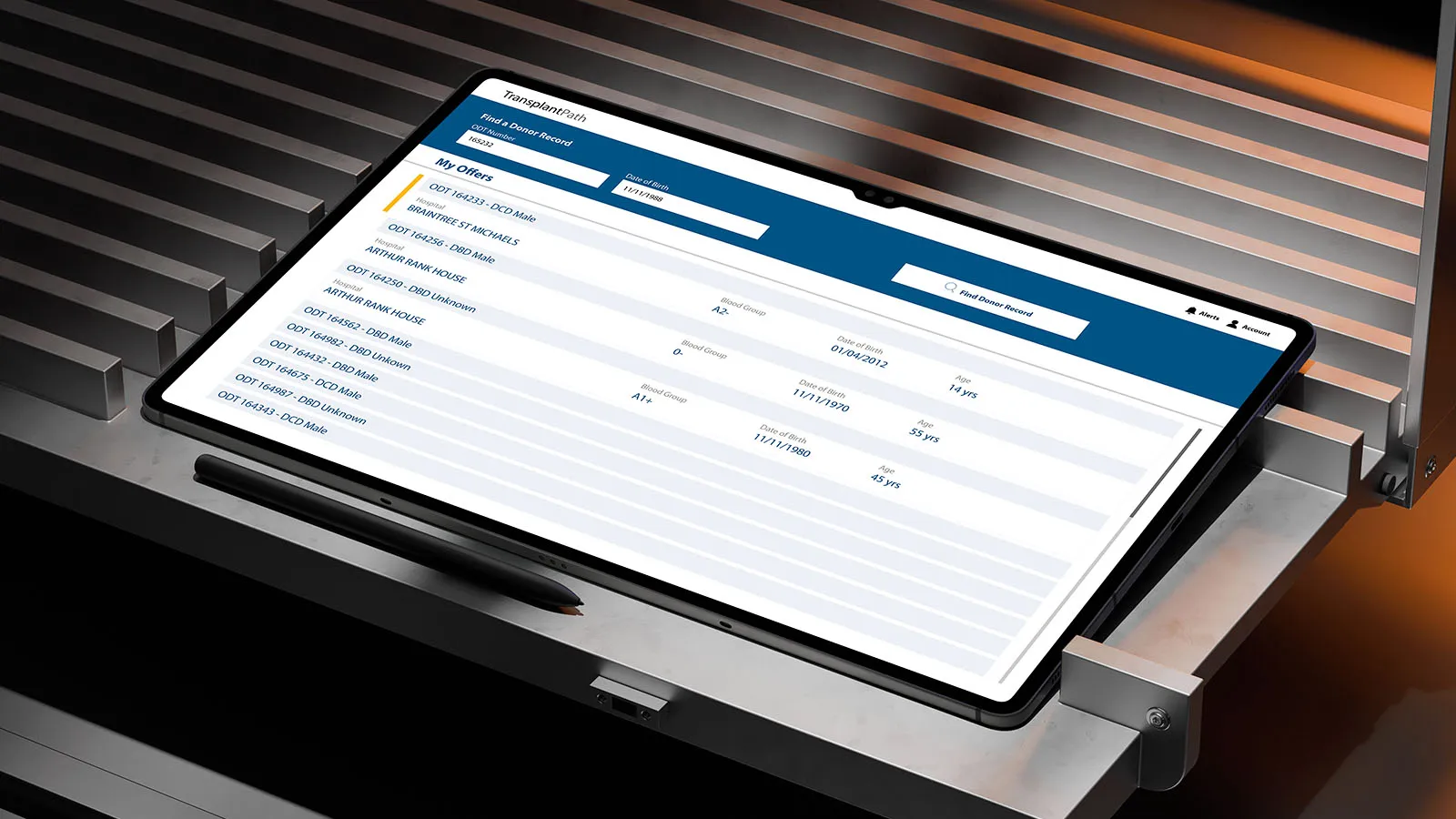
If DonorPath supports nurses at the point of donation, TransplantPath supports surgeons at the point of decision.
NHSBT’s goal is a world-leading organ donation and transplantation service that maximises the potential for deceased donations. TransplantPath is the digital infrastructure that makes that ambition operationally possible.
When an organ becomes available, transplant teams need immediate access to patient data, organ suitability information and clinical imagery, often overnight and across multiple sites.
The legacy system was slow, insecure, fragmented, not built for the mobile or the always-on nature of transplant surgery. TransplantPath replaced it with a secure mobile platform that gives retrieval and transplant surgeons rapid access to the information they need, while enabling organ offers to be accepted or declined through a standardised, auditable digital workflow.
Impact
A secure, mobile-first platform that provides reliable access to patient data and organ imagery, while standardising and auditing the organ offer process.
-
61
days per year saved in manual processes.
-
301
approximate number of additional transplants facilitated annually due to time savings
-
9000+
images shared securely via TransplantPath in first months following launch

Agile Transformation
Rebuilding how a critical NHS division delivers software
By 2024, the challenge was no longer what to build, but how to build it. Although leadership supported agile principles, delivery still relied heavily on waterfall practices. Development and testing ran sequentially, user acceptance testing came at the end of the delivery cycle, and work was spread across multiple reporting tools and spreadsheets. Apadmi and NHSBT also worked in separate Jira environments, creating duplicated effort and limiting visibility across the programme.
Previous attempts to modernise ways of working hadn’t taken hold. This time, the focus shifted from introducing agile processes to embedding agile capability within delivery teams that understood the live pressures of a safety-critical environment.
Embedding agile coaching
An Apadmi Agile Coach worked full time within NHSBT delivery teams, helping more than 60 people adopt agile ways of working through day-to-day delivery rather than classroom training.
For complex cross-team programmes such as OrganPath, the Nexus scaling framework was introduced to coordinate governance, manage dependencies and improve collaboration across multiple delivery squads.
One shared delivery model
Three strategic migrations moved teams into company-managed Jira projects with standardised workflows, creating a single view of delivery across every workstream.
Apadmi and NHSBT also moved from separate Jira environments and formal hand-offs to a shared workspace with joint backlog ownership, enabling both organisations to work as one integrated delivery team.
Continuous Quality
Testing became part of every sprint rather than a separate phase. Apadmi quality assurance engineers worked alongside NHSBT testers to resolve issues as they emerged, replacing sequential testing with continuous quality throughout delivery.
Four training cohorts upskilled more than 60 team members, while Communities of Practice ensured knowledge continued to spread after the initial transformation.
An internal Jira Admin Group, established during the transformation, reduced tooling change requests from days or weeks to hours—or even minutes—removing a persistent bottleneck from day-to-day delivery.
Agile in regulated environments
Safety-critical organisations are often seen as too heavily governed for agile delivery. NHSBT demonstrates the opposite. By integrating agile practices into existing governance, rather than replacing it, delivery became faster, more transparent and more predictable without compromising patient safety or regulatory compliance.
Over time, the relationship evolved from client and supplier into a genuinely integrated delivery team. Shared tools, joint backlog ownership, embedded coaching and paired quality assurance replaced formal hand-offs with shared ownership. The result was better visibility, stronger collaboration and faster delivery across the programme.
Impact
The shift to an integrated, agile operating model fundamentally changed delivery predictability, and speed.
-
230%
increase in epics delivered in 2025
-
2+
weeks in time savings per release
-
4.0/5
delivery predictability rating

A decade of impact
It’s easy to tell this story as a series of successful projects. The bigger achievement is the partnership behind them.
Over ten years, DonorPath reduced paperwork for specialist nurses. TransplantPath helped surgeons make faster, better-informed decisions. The agile transformation gave the Product Centre the internal capability to keep improving, at pace, on its own terms.
Today, the partnership supports 1,281 active TransplantPath users and has enabled the secure upload of more than 9,000 clinical images. Beyond the technology itself, 45+ NHSBT team members have been upskilled through three agile training cohorts, and Jira consolidation has delivered 100% reporting visibility across every workstream.
Across 43 project phases, the goal has remained the same: build technology that works when every minute matters.
Read more success stories
From retail and healthcare to FMCG and media, we help ambitious organisations solve complex challenges, drive revenue, and build loyalty with exceptional digital products and mobile apps.